PERFECTUS Institute
PERFECTUS Institute

A new GGS programme for vitality, memory and safe movement in later years

The
Music-Movement-Memory Programme

The programme combines music, safe adapted movement, mental activation and social contact.

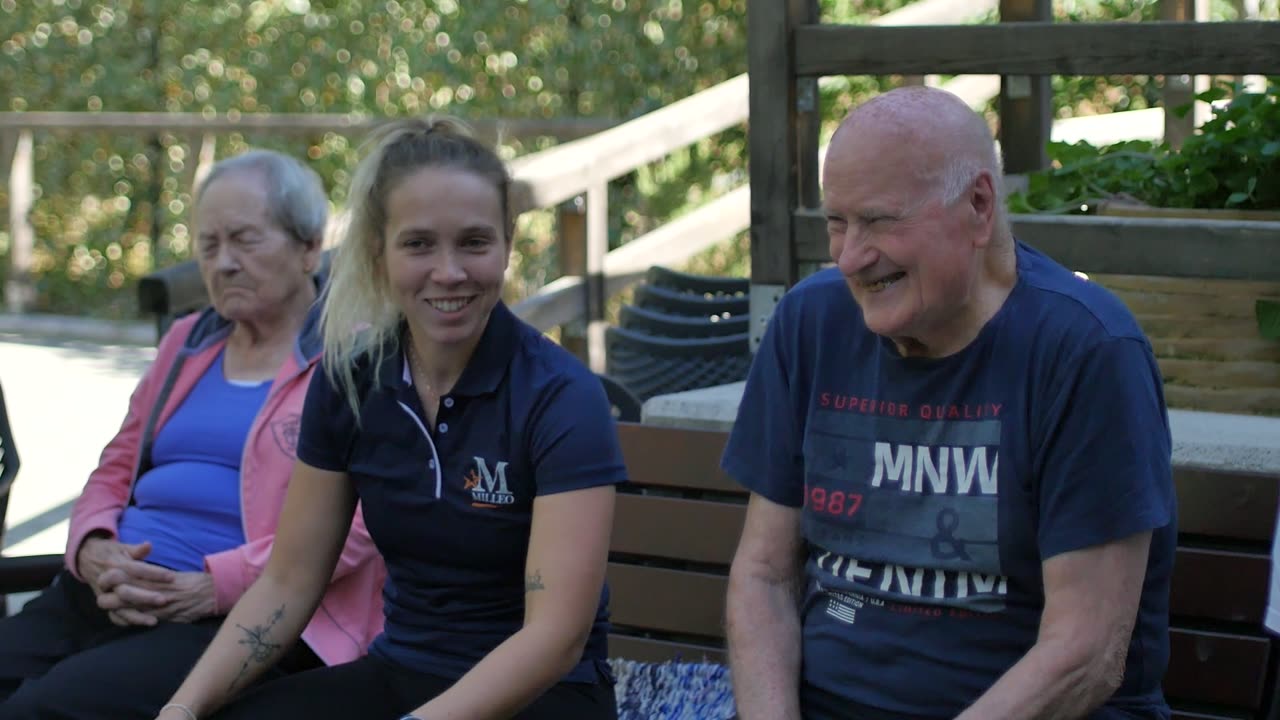
Relaxed social contact and laughter among GGS programme participants.

Current project

Music-movement-cognitive programmes supporting the emotional, cognitive and psychophysical health of older adults

The project develops comprehensive music-movement and cognitive programmes for older adults, aimed at supporting physical health, mental ability, emotional balance and social inclusion. By combining music, movement and adapted cognitive exercises, the project contributes to active ageing and creates professionally grounded, user-adapted forms of support for older people.

Co-funded by the European Union – Perfectus Institute projectI feel SloveniaLogo of the Ministry of the Economy, Tourism and Sport

Project background

Population ageing represents an increasingly important social, health and societal challenge. In the Vipava Valley and the wider Northern Primorska region too, there is a growing need for quality, accessible and professionally designed programmes that help older people maintain physical health, mental ability and emotional balance and live independently for as long as possible. Existing provision is often fragmented and focused only on isolated aspects of physical exercise, social contact or rehabilitation, while comprehensive programmes that combine different approaches into a coherent, user-adapted whole are lacking.

Ageing can bring reduced muscle strength, poorer mobility, problems with balance and coordination, and a gradual decline in cognitive ability. Older people also often experience loneliness, a lack of social contact, anxiety and reduced involvement in local community life. These factors can significantly affect a person's wellbeing, their ability to carry out daily activities and their overall quality of life. Particular attention is needed for older adults with movement limitations, chronic illnesses or neurodegenerative changes, who require safe, professionally led activities adapted to their abilities.

Music, movement and mental activities hold significant potential for promoting healthy and active ageing. Music can positively influence mood, motivation, memory and social connection, while appropriately adapted movement helps maintain strength, mobility, balance and independence. Performing movement and cognitive tasks at the same time further stimulates attention, coordination, responsiveness and other mental processes. Combining them therefore provides a sound basis for developing comprehensive services that treat the older person not merely in terms of a single health issue, but with regard to their physical, mental, emotional and social wellbeing.

The project also stems from the need to develop non-institutional forms of support for older people and to strengthen cooperation between the social enterprise, local communities, care homes, pensioners' associations, healthcare institutions, day activity centres and other organisations. By connecting different areas of knowledge and settings, an offer can be created that is accessible to a wider range of users and adapted to their health status, living circumstances and actual needs.

Project description

Project description:

The project is aimed at developing comprehensive music-movement and cognitive programmes for older adults, with the core purpose of supporting physical activity, maintaining mental ability, emotional wellbeing and social inclusion. The programmes will combine music, rhythmic movement, adapted physical exercises, tasks to stimulate attention and memory, and other activities designed with reference to expert knowledge from kinesiology, gerontology, rehabilitation, neuroscience and mental health.

Various content formats will be prepared within the project, adapted for healthy and independent older adults as well as for people with movement, health or cognitive limitations. Activities can be carried out in groups or individually, with their difficulty adapted to the abilities, health status and goals of individual users. Particular attention will be paid to safe delivery, gradual progression, an enjoyable user experience and creating an encouraging environment in which participants feel included, accepted and motivated.

Development will proceed from preparing the professional and delivery concept through to designing usable programme content. The approaches prepared will be tested together with representatives of the target group, and their experience and feedback will be used to improve the content, working methods and organisation of delivery. Based on the findings of testing, final versions of the programmes will be developed, suitable for delivery on the social enterprise's premises, at partner organisations or in other settings where older people take part in organised activities.

An important part of the project will involve engaging local and regional stakeholders. Cooperation with care homes, pensioners' associations, healthcare and social welfare institutions, educational organisations and day activity centres will make it easier to reach users, better understand their needs and establish conditions for the long-term delivery of the services. Stakeholders will be able to help inform users, organise sessions, adapt activities and incorporate the programmes into their existing offer.

Once development and testing are complete, the programmes will be brought to market and presented to potential users, their families and organisations working with older people. Communication will take place through online content, social media, direct outreach, cooperation with the media and personal engagement with stakeholders. In this way the project will lay the foundation for the ongoing delivery of activities, further development of the programmes and the growth of the social enterprise as a professional provider of comprehensive support for healthy and active ageing.

Beneficiary:
PERFECTUS Institute, private social institute, social enterprise, Dolga Poljana 57, 5271 Vipava, Slovenia
Project duration:
1 December 2025 to 1 October 2026
Value of co-funding:
EUR 16,060.80
Public call:
Public call for promoting cooperative and social economy projects and launching social entrepreneurship

Music that awakens. Movement that connects. Memory that stays active.

The Music-Movement-Memory (GGS) programme was developed under the professional guidance of kinesiologist Dr Mitja Gerževič by PERFECTUS Institute, private social institute, social enterprise, as part of the project "Music-movement-cognitive services for older adults". The programme uses music as an active stimulus, adapts movement to the group's functional abilities, and naturally incorporates mental tasks into rhythm, coordination and social cooperation.

A professionally grounded, comprehensive approach to active ageing

Population ageing brings challenges in the physical, cognitive and social domains. The GGS programme therefore does not offer a single activity, but a structured, safe and enjoyable experience that combines movement, mental activation, emotional wellbeing and social connection.

The programme promotes physical activity, balance, coordination, strength, flexibility, memory, attention, wellbeing and social contact. Activities are carried out seated, standing, with support or in a more dynamic form, and are adapted to different groups – from active, independent older adults to those with movement limitations, balance problems, a risk of cognitive decline or a greater need for support.

"Older people don't just need exercise, singing or mental tasks — they need a safe and enjoyable activity that connects body, mind, emotions and social contact."
— Dr Mitja Gerževič

Three connected pillars

1

Music and rhythm. Familiar melodies, singing, clapping, musical cues and associations stimulate motivation, wellbeing, memory and group connection.

2

Safe and adapted movement. Exercises support functional mobility, strength, coordination and balance, and build confidence in everyday movement.

3

Mental activation and challenges. Following rhythm, remembering sequences and responding to sound cues stimulate attention, memory, orientation and mental agility.

A tested and adaptable programme

The programme was piloted in cooperation with institutions and organisations for older adults in the Gorizia region and the Vipava Valley, and feedback from participants and professional staff was incorporated into the further development of the content. It is intended for care homes, pensioners' associations, day activity centres, universities of the third age, municipalities and other organisations. It can be delivered as an introductory workshop, a short trial cycle or a regular weekly activity, without demanding equipment and within the commissioning organisation's existing premises.

The project is co-funded by the Ministry of the Economy, Tourism and Sport of the Republic of Slovenia.

Five modules of the GGS programme

All modules stem from the same professional framework, but differ in target group, difficulty, form of support and the main effect the commissioning organisation wants to achieve. The module is chosen following a short conversation with the commissioning organisation and a basic assessment of the group's characteristics.

Swipe sideways →

ModuleProduct nameBest-suited groupMain focus
AActive and Creative Ageingactive, independent older adultsvitality, prevention, creative movement
BSafe Movement with Rhythmolder adults with early movement limitationsmobility, balance, safety
CRhythm, Memory and Movementolder adults at risk of cognitive declineattention, memory, dual tasks
DSupportive Therapeutic Programmemore vulnerable older adults with a greater need for supportgentle psychophysical activation and wellbeing
ETogether in Rhythmsocially isolated older adults and groups with fewer opportunities for social contactconnection, belonging, cooperation

All modules follow a flexible session framework: introduction and orientation, music-rhythm activation, the main combined block, winding down and a short conclusion. Each session usually lasts 30 to 60 minutes, depending on the module and the group's abilities.

MODULE A

Active and Creative Ageing

A dynamic preventive programme for older adults who want to stay active, curious and connected.

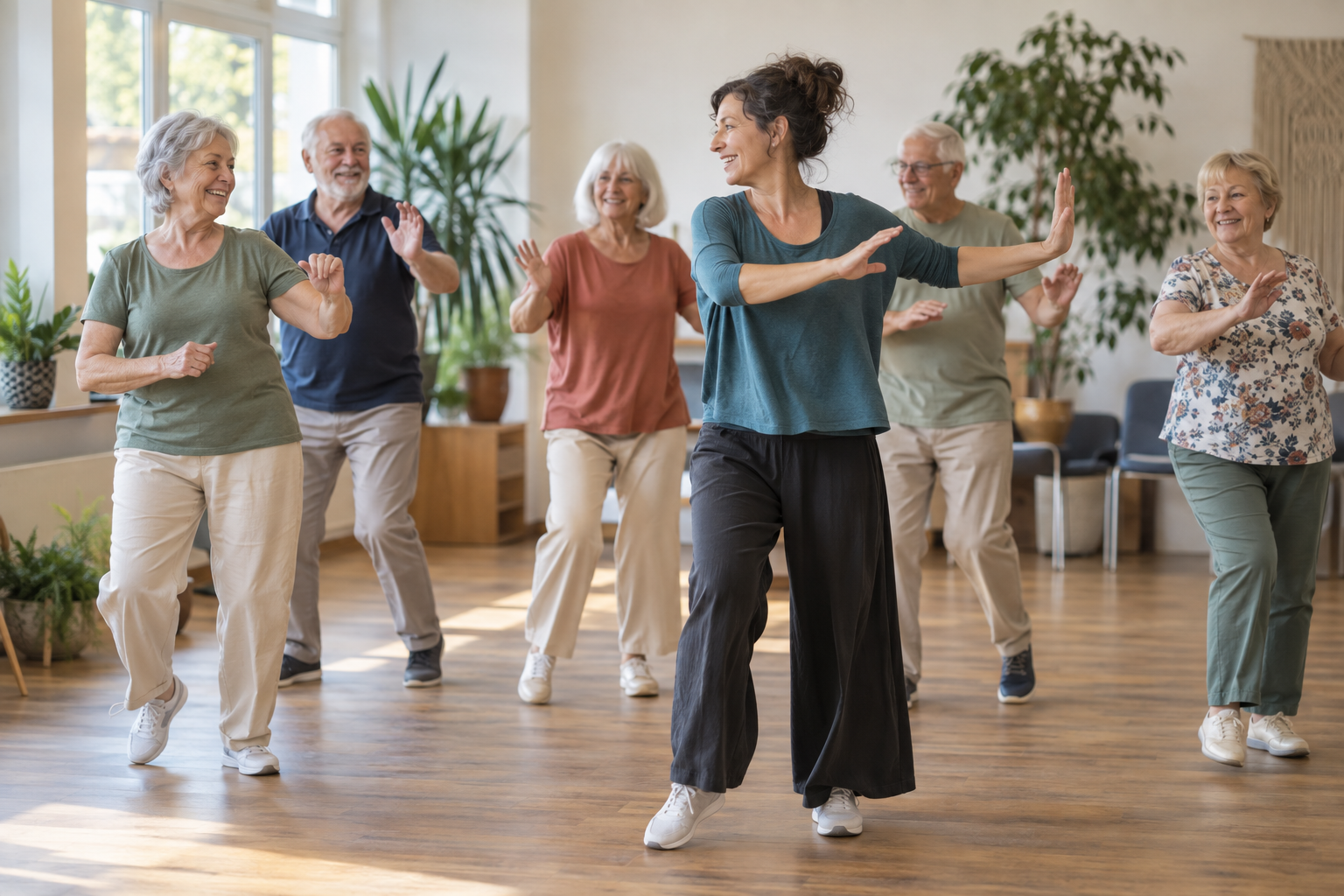
Active older adults in a bright room performing dynamic rhythmic movement and a simple dance sequence led by an instructor.
A dynamic combination of rhythm, coordination, creative movement and group energy.
Who it is for
Active, independent older adults, members of associations, universities of the third age and activity centres.
Main focus
Vitality, fall prevention, coordination, balance, strength, creativity and mental agility.
Suggested delivery
An introductory workshop, an 8- to 12-week group cycle, or a regular weekly activity; typically 45 to 60 minutes.

What it includes

  • rhythmic warm-up and dynamic exercises for mobility, strength and balance
  • light dance-movement combinations and group choreography
  • more demanding coordination tasks, changes of rhythm and direction
  • mental challenges during movement, sequence-building and cooperative games
  • winding down, breathing exercises and a short reflection at the end

Value for participants and the commissioning organisation

Participants gain an appealing way to maintain physical activity, confidence in movement and mental agility. Commissioning organisations gain a distinctive, content-rich programme for active older adults that can be gradually developed and regularly offered.

Suitable for organisations that want to offer active older adults more than an ordinary group exercise class.

MODULE B

Safe Movement with Rhythm

An adapted programme that builds confidence in movement and allows participation while seated, standing or supported.

Safe exercise with adaptations, support and a clear rhythm for varying levels of mobility.
Who it is for
Older adults with early movement limitations, poorer balance, reduced strength or lower confidence in movement.
Main focus
Mobility, balance, functional strength, coordination and safe participation.
Suggested delivery
A group cycle with an initial assessment of the group's characteristics; 30 to 60 minutes; seated and standing versions are always available.

What it includes

  • movement from a chair, standing up, standing and stepping with stable support
  • exercises for strength, flexibility, balance and coordination within a safe range
  • rhythmic tasks with balls, resistance bands or other light equipment
  • short, gradual instructions with direct demonstration and repetition
  • individual pacing, breaks and adjustment of the range of movement

Value for participants and the commissioning organisation

Participants take part at their own pace and retain a sense of achievement. Commissioning organisations receive a structured activity suited to their existing premises, with staff support available for more vulnerable groups.

Suitable for care homes, day centres and groups where safety is a precondition for participation.

MODULE C

Rhythm, Memory and Movement

A programme for older adults who want movement combined with active stimulation of attention, memory and responsiveness.

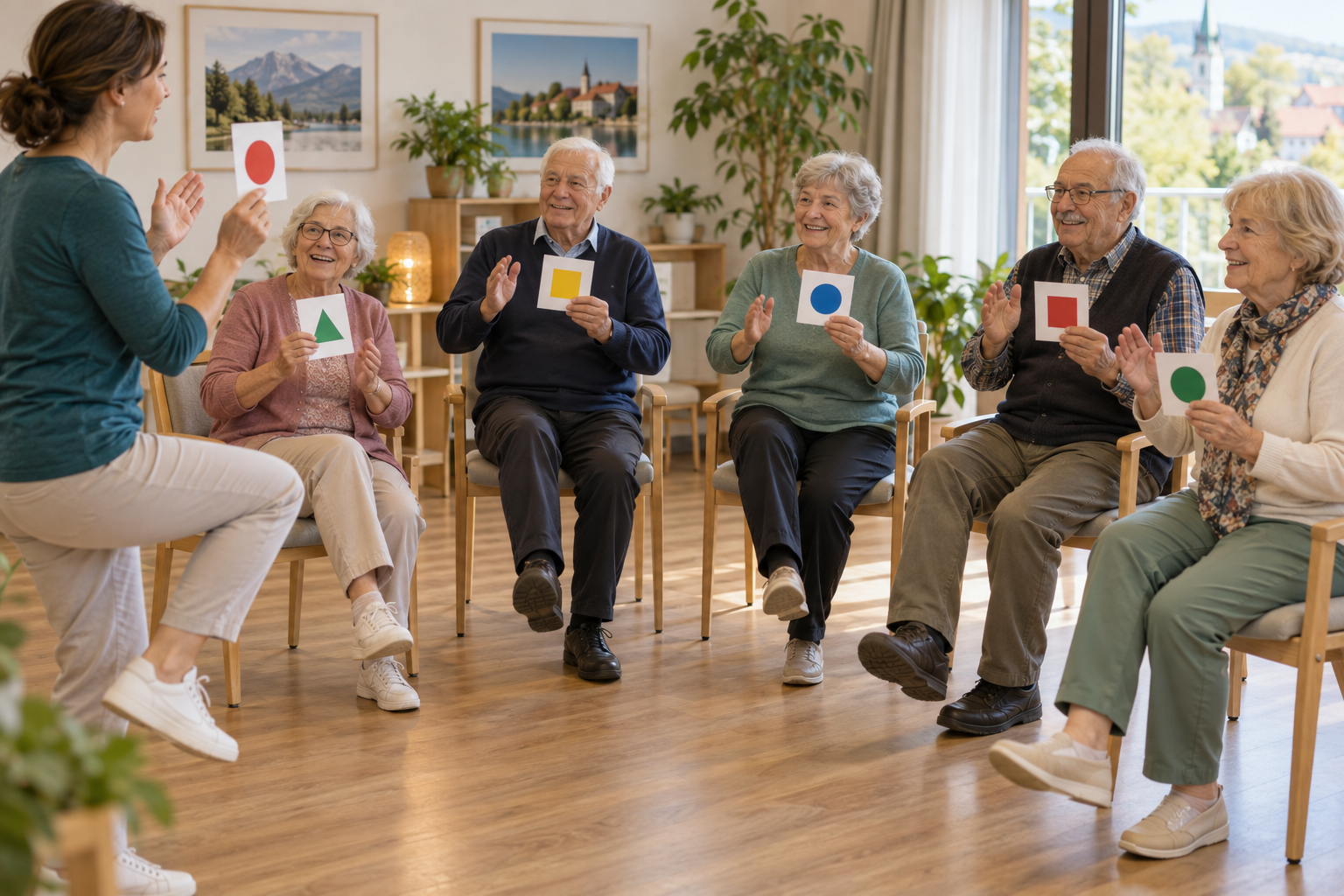
A group of older adults in a semicircle follow rhythmic movement instructions and colourful cards with simple geometric symbols.
Movement tasks combined with rhythm, visual cues, sequences and memory associations.
Who it is for
Older adults with subjective memory concerns or a risk of cognitive decline, who can follow basic instructions.
Main focus
Attention, working memory, responsiveness, orientation, decision-making and mental agility.
Suggested delivery
A small to medium-sized group; 40 to 60 minutes; tasks progress from simple responses to dual tasks.

What it includes

  • responding to a change in rhythm, a musical cue, colour or gesture
  • repeating and completing short movement-rhythm sequences
  • memory associations linked to familiar melodies and everyday themes
  • movement involving choices, rule changes and simple dual tasks
  • clearly graded difficulty, sufficient response time and positive feedback

Value for participants and the commissioning organisation

The programme creates an encouraging environment in which mental challenges are linked to movement and social contact, so they do not feel like testing. Commissioning organisations gain a structured cognitive stimulation offer with clear options for adaptation.

Suitable for communities that want to stimulate memory and attention in an active, enjoyable and non-stigmatising way.

MODULE D

Supportive Therapeutic Music and Movement Programme

A gentle, personalised programme for more vulnerable older adults who need more time, support and direct assistance.

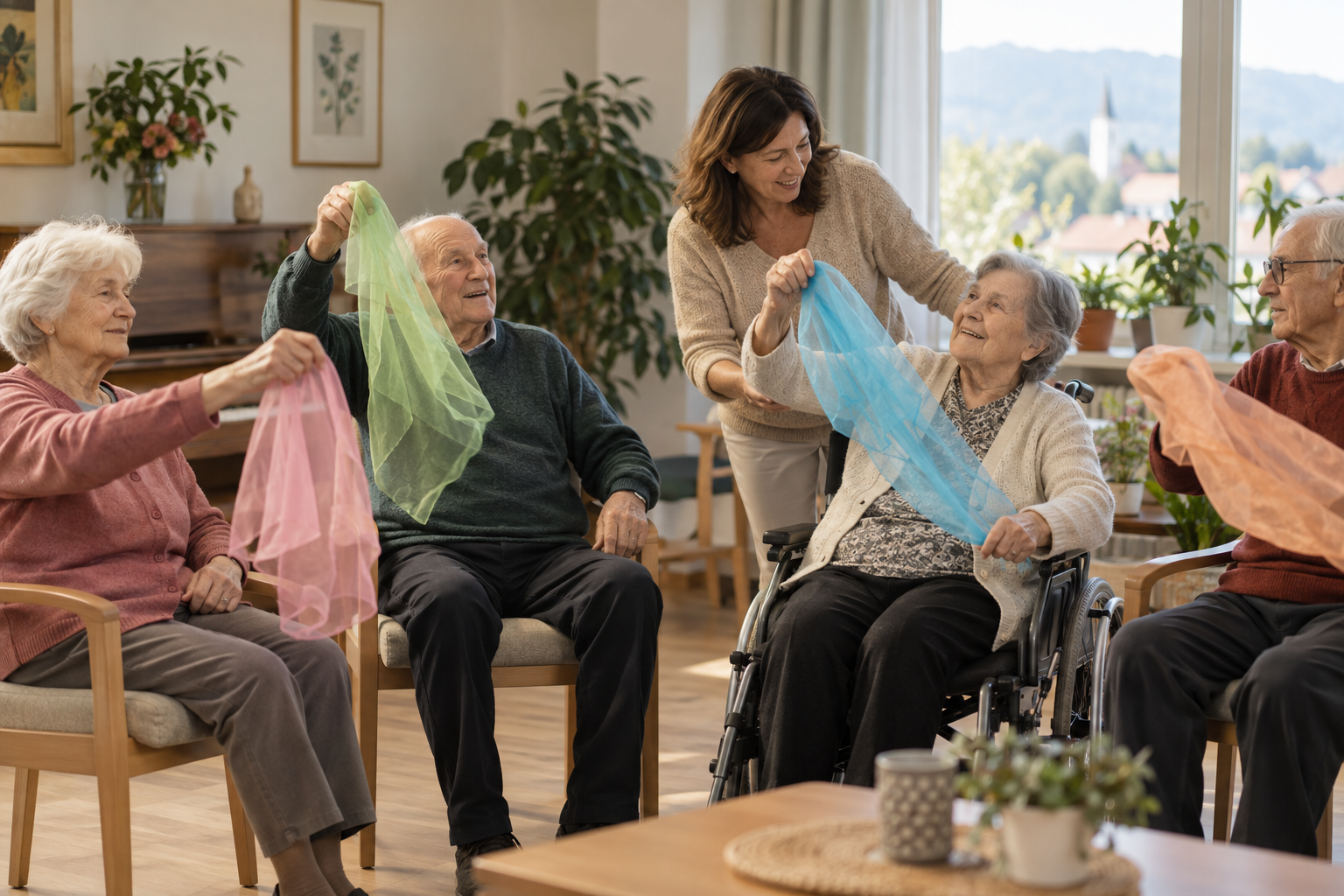
A small group of very elderly participants sit in a circle performing gentle movements with light coloured scarves with direct support from the instructor; one participant uses a wheelchair.
Gentle activation at a safe pace, with plenty of support and the option of individual adaptation.
Who it is for
More vulnerable older adults with more pronounced movement, health or cognitive limitations and a greater need for support.
Main focus
Wellbeing, gentle psychophysical activation, sustained participation, sensory stimulation and contact with others.
Suggested delivery
A small group, individual or semi-individual delivery; typically 30 to 45 minutes; staff or a companion present where needed.

What it includes

  • mostly seated, slow and short movement tasks within a comfortable range
  • familiar melodies, singing, simple rhythm and sensory musical stimulation
  • very short instructions, direct demonstration, more repetition and a longer response time
  • light equipment, breathing, relaxation and activities to lift mood
  • ongoing monitoring of fatigue, pain, balance and understanding of instructions

Value for participants and the commissioning organisation

Allows safe participation even with limited independence. Commissioning organisations gain a flexible complementary activity for everyday quality of life and contact with others. The programme does not replace physiotherapy, occupational therapy, medical treatment or rehabilitation.

Suitable for smaller groups and users for whom the quality of support matters more than the volume of tasks.

MODULE E

Together in Rhythm

A community-connecting programme that uses music and shared movement to create opportunities for contact, belonging and joy.

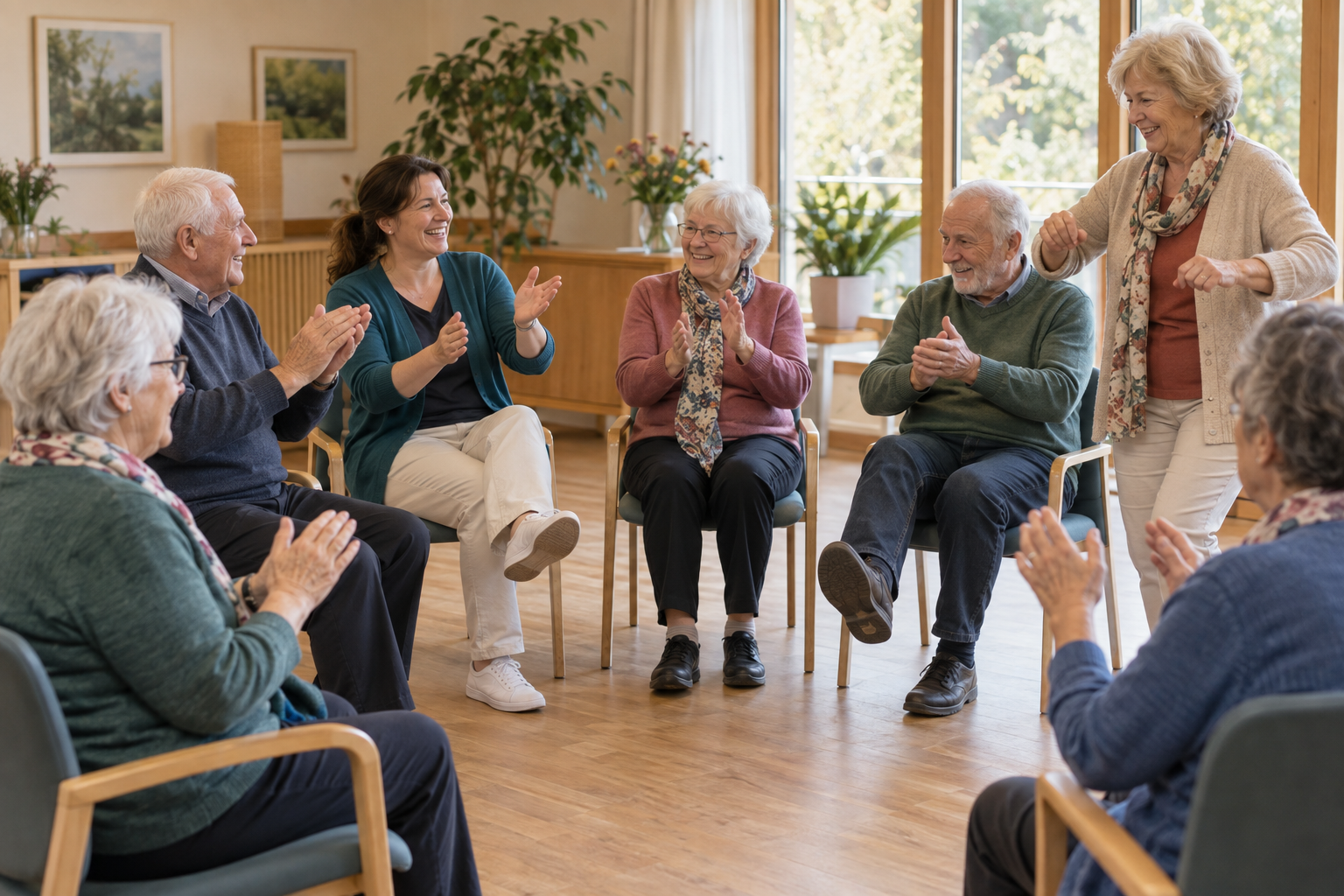
Older adults with varying levels of mobility sit and stand in a circle, clapping a shared rhythm and looking at and laughing with each other during the activity.
A shared rhythm as the starting point for social contact, cooperation and a sense of belonging.
Who it is for
Socially isolated older adults, older adults with few opportunities for social contact, and open local or intergenerational groups.
Main focus
Social connection, cooperation, communication, positive mood and regular involvement in the community.
Suggested delivery
An open group workshop, a multi-week cycle or a regular gathering; 45 to 60 minutes; adaptable to varying abilities.

What it includes

  • group singing, clapping and simple rhythmic patterns
  • movement tasks in a circle, in pairs or in a small group
  • getting-to-know-you games, cooperation and friendly mutual encouragement
  • familiar local melodies, memory themes and space for personal contributions
  • activities in which everyone takes part according to their own ability and remains part of the group

Value for participants and the commissioning organisation

The programme reduces barriers to participation and offers a regular, meaningfully guided reason to meet. Commissioning organisations can develop an accessible community activity that can connect associations, municipalities, activity centres and intergenerational initiatives.

Suitable for settings where the main goal is for older adults to meet, take part and feel a sense of belonging to the community again.

Results

Proven in practice

The pilot trial of the programme ran between 17 August and 18 September 2026 across five locations in the Gorizia region and the Vipava Valley. 24 pilot sessions and one introductory workshop were held. The results confirm high acceptance and practical feasibility of the programme when difficulty is consistently adapted.

Delivery reach
5 locations, 75 recorded distinct participants and 295 attendances
Attendance
92.2 per cent of all recorded attendance opportunities
Participant ratings
97 evaluation units, descriptively combined average of 4.77 out of 5; 95.7 per cent of ratings were 4 or 5
Professional staff ratings
average of 4.70 out of 5; 96.9 per cent of ratings were 4 or 5
Feasibility as rated by instructors
197 out of 200 structured ratings reached the highest level; overall average 2.99 out of 3

The best-received elements were music, movement, dance, social contact, a pleasant atmosphere, a sense of safety, varied exercises and the use of equipment. The pilot also showed that instructors need to give instructions briefly and step by step, increase the difficulty of more demanding tasks gradually, and always offer a seated or supported alternative.

Methodological note: Evaluation units were not the same across all locations and do not necessarily represent the same number of distinct individuals. The results therefore represent a descriptive summary of the pilot trial, not proof of a medical or therapeutic effect.

For commissioning organisations

Ways to collaborate

The commissioning organisation can choose the scope that best suits the target group and organisational possibilities. The final delivery is adapted to the module, number of sessions, group size, location and required level of support.

01

Introductory workshop

A one-off 45- to 60-minute session to get to know the programme, gauge the group's response and identify the suitable module.

02

Short trial cycle

Several consecutive sessions to test feasibility and adapt the content before regular delivery.

03

Core programme

A recommended 8- to 12-week cycle with regular weekly delivery and gradual progression.

04

Regular activity

A longer-term weekly or otherwise agreed delivery as part of the commissioning organisation's ongoing offer.

05

Adapted delivery

A smaller group, individual or semi-individual format for participants with a greater need for support.

What the commissioning organisation provides

  • a safe, sufficiently spacious room free of obstacles, with stable chairs
  • basic information about the group and a contact person for coordination
  • the ability to play music and use the organisation's equipment, or an agreement on the instructor bringing portable equipment
  • where needed, the presence of staff or a companion for more vulnerable groups

Contact and invitation to collaborate

Would you like to choose the most suitable module for your group, or start with an introductory workshop? Together we will define the participants' characteristics, the goals and the form of delivery, then prepare a tailored programme proposal.

Send an enquiry
Provider
PERFECTUS Institute, private social institute, social enterprise
Contact person
Dr Mitja Gerževič, kinesiologist and director